What Local Conditions Do
Most houses around here went up between 1954 and 2005, with the bulk clustered in the 1960s and '70s across neighborhoods like Brandermill, Woodlake, and Charter Colony. That matters because a door's noise profile changes with its age, and a lot of these doors are original or close to it.
The climate band this area sits in is cold-moderate, not the deep freeze you get further north, but enough that winter mornings stiffen torsion springs and thicken old grease on tracks that haven't been serviced in years. A squeal on a 20-degree morning that disappears by afternoon isn't your imagination - it's lubricant that's too cold to do its job, sitting on hardware that's been doing this same job since before most of us owned the house.
Homes out toward Bon Air or Manchester tend to run the same era of stock, so the pattern holds across a wide stretch of the area, not just one street. A door built to 1970s spec wasn't engineered with today's insulated panels or nylon rollers, so the sounds it makes as it ages are different from what you'd hear out of something installed in the last ten years.
When to Get Help
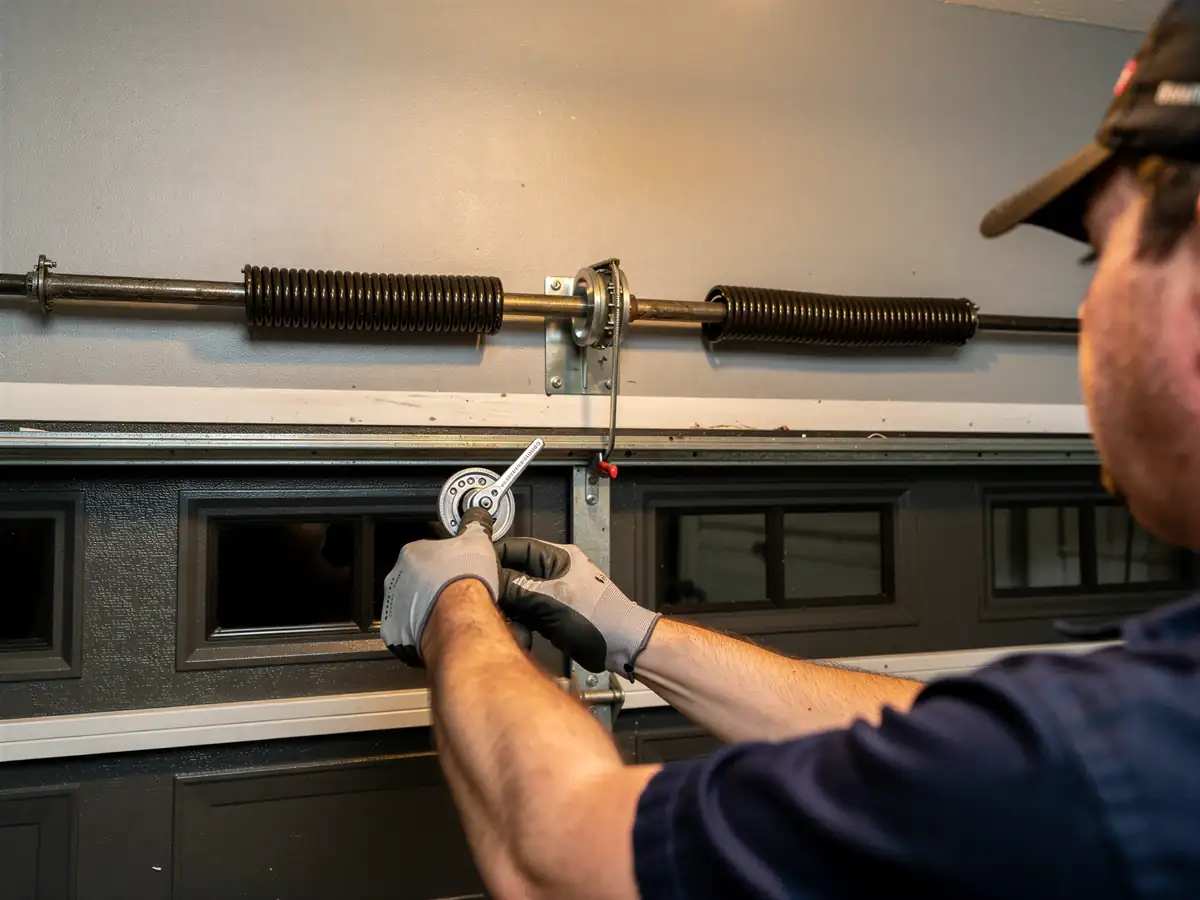
A rhythmic thump once per rotation usually means a flat spot on a roller - annoying, not urgent. A sharp bang followed by the door refusing to move is almost always a broken torsion spring, and that's not a noise to wait out. The spring is under enough tension to do real damage, and the door isn't safe to force open by hand.
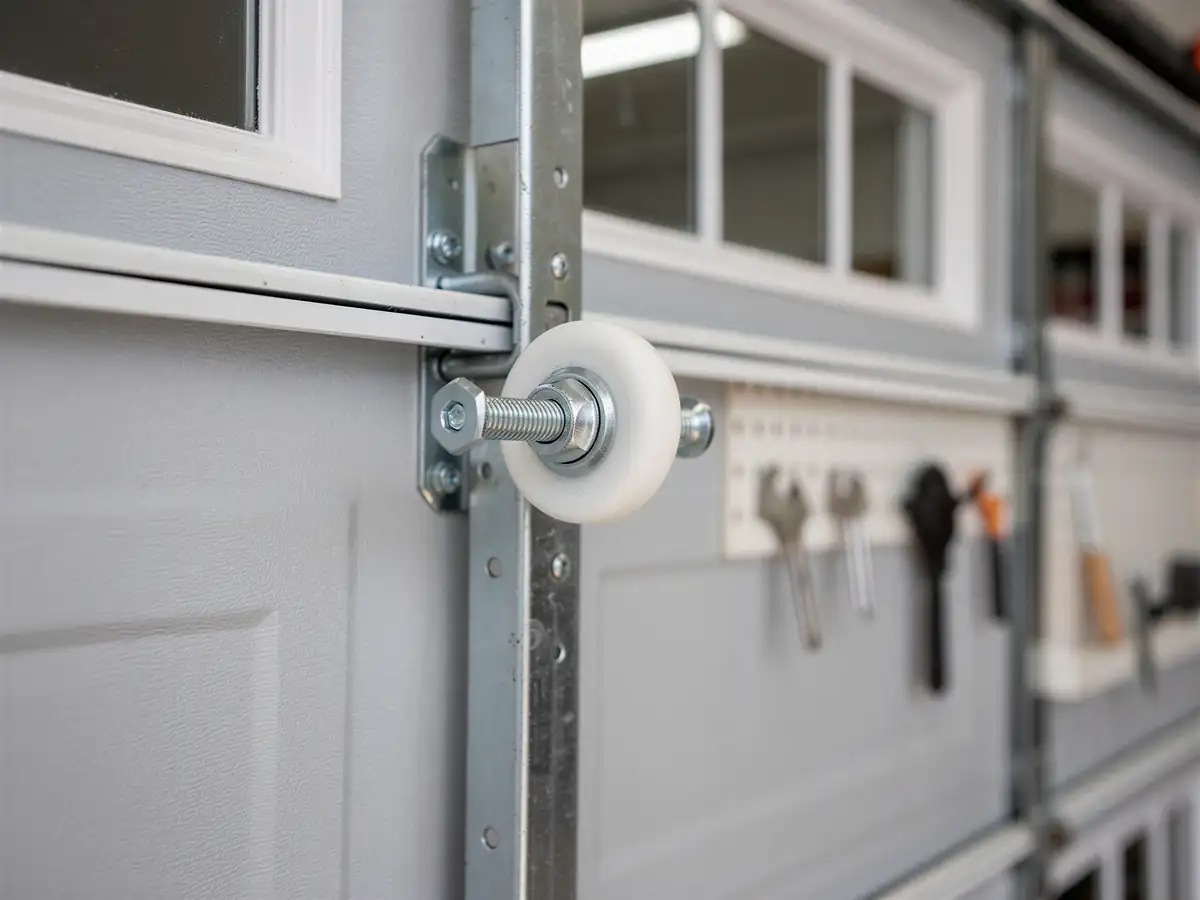
Grinding that gets louder over weeks points to a worn bearing or a track pulling out of alignment, which happens more on original 1960s and '70s installations than on anything newer. A chain opener that's started slapping or rattling partway through the cycle is often a loose sprocket, not a dying motor - worth a look before you replace the whole unit.
If a noise shows up suddenly and the door's travel changes - it stops short, reverses on its own, or hangs at an angle - stop using it. That's not a lubrication problem, that's a structural one, and running it again risks turning a repair into a replacement.
What Most People Get Wrong
The most common mistake we see in houses built in this era is spraying WD-40 on everything and calling it maintenance
It's a solvent, not a lubricant - it strips what grease is left on torsion springs and rollers instead of protecting them, and on hardware that's already decades old, that speeds up the exact wear that's causing the noise.
The second mistake is assuming a noisy door means a dying opener
With 32,837 owner-occupied houses across this service area, a lot of those original torsion springs are still the first ones installed, and the opener motor is usually the healthiest part of the whole system. Swapping the opener and leaving the spring and rollers alone just means the new motor inherits the old noise.
- 32,837 owner-occupied
The third is waiting too long because the door still opens
At a median household income of $69,917, most owners here are weighing a $300 spring repair against a job that was never going to last another decade anyway - and that's a fair call to make. But it has to be an informed one, not a default from putting it off.
The Situation
Across roughly 72,105 households in this service area, the housing stock skews old enough that original hardware is still common, which means the noises we get called about tend to repeat: dry rollers, aging torsion springs, loose track brackets, and openers compensating for all three at once.
If you're in Charter Colony, a mile northwest, or out toward eight miles southwest, the opener strain sounds the same - but the hardware underneath it is often forty years older than the house next door built after 2000. The sound doesn't care about the neighborhood name; it cares about the installation date.
One limitation worth naming: we don't do cosmetic panel matching on doors old enough that the original manufacturer no longer makes that profile. If a single panel is dented on a door from the 1970s, the honest answer is sometimes a full door rather than a patch, and we'll tell you that instead of pretending otherwise.